 Download PDF of this full issue: v56n2.pdf (37.4 MB)
From Vietnam Veterans Against the War, http://www.vvaw.org/veteran/article/?id=4600
| Download PDF of this full issue: v56n2.pdf (37.4 MB) |
Our point man died last month—we called him Bo.
I remember him first entering our hootch, a swarthy fireplug of a guy nearly as broad as tall. He carried an enormous seabag as if it weighed nothing and threw it onto the empty bunk next to mine. Over time we became friends.
He came from western Pennsylvania's steel country and had been working as an apprentice machinist in "the mill" when he got his draft notice. His boss told him that since steel was an "essential industry," he could get him a deferment, but Bo refused. He said that he wouldn't have felt right letting others serve in his place. The year was 1968, and at the time most of us felt the same way.
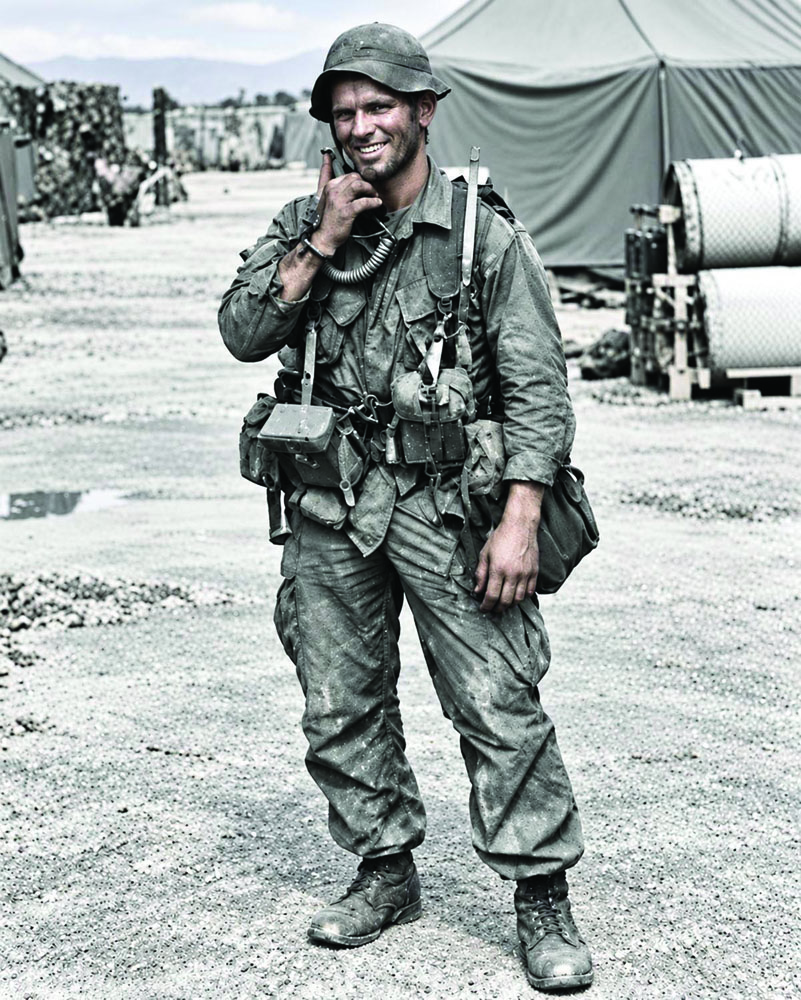
After he had been on a few patrols, our Sergeant picked Bo to "run point," the most dangerous position on the team. The point man chose the path the rest of us followed, and he was often the first to engage the enemy. He also needed to be constantly watching for booby traps and other dangers. A single mistake could cost the lives of every member of the team.
Being short helped because it made you less of a target, but a good point man needed more than that to survive. Bo seemed to flow through the jungle, moving slowly, carefully, and completely silently. He had a quiet "steadiness" about him. I never saw him panic; he was a man you could rely on.
These qualities made him an exceptional Marine, yet he was never recognized with rank or medals. When Bo entered our hootch, he was a PFC, and he was only promoted near the end of his tour. Perhaps it was his unassuming nature, but there might have been other reasons. Our six-man teams were usually led by sergeants, usually men who had been on multiple tours and had attended a variety of Recon training schools. They knew their shit, but officers recommended promotions, and at the time, our missions were nearly always led by sergeants.
The officers certainly didn't seem to have any problems promoting the office "pogues" who worked closely with them in the rear. Our Major's clerk went from PFC to Sergeant in less than a year. He must have been one hell of a typist!
It was the same thing for medals. As far as I knew, Bo never received any, but even if he had, he probably wouldn't have told me. He was the last person to "blow his own horn."
Officers seemed to write one another up at the drop of a hat. On one patrol we joined another team led by a new lieutenant. Our mission was compromised, and we had to "beat feet" back to our extraction point. A few months later we watched as the lieutenant was decorated for "extraordinary bravery." After the award ceremony, Bo turned to me and remarked dryly, "I guess he ran faster than the rest of us!"
Bo was never bitter about the lack of rank or medals. Surviving one more day in Nam was good enough for him, but I, for one, sure would have liked to have seen him recognized for something. After risking his life on so many missions, he certainly deserved it!
Many years after I returned home, the phone rang, and I heard Bo's gruff voice for the first time in years: "Hey man! How ya doin?" He had somehow managed to track me down. It was so good to hear from him again.
He told me that after leaving the Marines, like so many of us, he had struggled to find work. When he returned from Nam, the anti-war movement was tearing America apart, and no one wanted to hire a Vietnam vet. The job at the mill that he had been promised would be "waiting for him" when he got back had been given to another, and a long time passed before he was finally able to find another. He told me that he also worked weekends at a local liquor distributorship. Remembering how many beers I had watched him put away, I told him he had finally found the perfect job!
The years passed, but we remained in touch. He hadn't changed a bit. He was still the same "salt of the earth" guy I had always known. The phone would ring, and I'd listen as he told me about his work, his growing family, and his beloved Little League baseball team. Over decades of coaching, Bo must have influenced hundreds of young ball players. The kids couldn't have had a better role model.
We rarely talked about Nam; I guess we both wanted to put it behind us. Occasionally, one of us would hear from someone we knew from the service. Many of whom seemed to have been seriously traumatized by their experiences. Bo and I assured each other that at least we were both fine. That was not completely true, of course, but that's what we told each other.
About ten years ago Bo mentioned some medical problems. He brushed them off as minor, but I was concerned. It told him that his symptoms might be the result of Agent Orange exposure. I reminded him of the time we moved through a valley that that orange shit had sprayed. Everything had been killed off, the birds, the animals, even the insects. The trees were so brittle that their branches shattered like glass if you so much as touched them.
At the time we had been told that Agent Orange was harmless to humans. That was a bald-faced lie. The chemical companies making Agent Orange knew full well that they had created one of the most potent carcinogens ever developed. Still, they were making hundreds of millions of dollars a year off the hellish stuff, and they wanted to keep the cash coming in for as long as possible—even if people died.
Twenty years after the war, the courts finally held the chemical companies to account, and the VA set aside funds to compensate victims. When I told Bo that he was probably eligible for compensation, he said that he was doing OK, and that the money should be used to help others who needed it more. That was Bo for you.
Last month, the phone rang, and Bo's name appeared on my screen. I picked up, looking forward to hearing from him about ball games and family cookouts—but this was not to be. In a tearful voice, his wife told me that my friend had passed away early that morning. I was shocked. I had no idea that he was that sick. She said that he had been seriously ill for a long time but hadn't told me because he didn't want me to worry about him.
Now I'm not going to pretend that Bo was perfect. He was a combat Marine who lived through a violent time. How he would have laughed if I portrayed him as some kind of saint!
And yet, unlike so many others, he hadn't allowed the war to change him. He was faithful to his friends, his family, and his community. He lived a life of service and commitment. He never thought of himself as someone special. He simply believed that you did what needed to be done, you looked after the people beside you, and you didn't ask what you could get in return. Perhaps that is what I will miss the most about him.
This Veterans Day, as we honor all those who have served our country, we should also remember that our nation is built on more than economic wealth and military might. The character and sacrifices of ordinary people support it. If America loses the values that men like Bo embodied, what will be left to hold our nation together? Semper Fi, Bo.
Richard Fleming served as a recon scout with 1st Force Recon Co. from 1968-1969. He wrote about his experiences in "Chasing Charlie-A Force Recon Marine in Vietnam."
|